01
A wavelength is not a treatment by itself
Low-level light therapy, also called photobiomodulation, uses a defined light source and dose intended to influence tissue without heating it like a surgical laser. A consumer description such as red light leaves out wavelength, power, contact, coverage, treatment time and how much light reaches the scalp.
The evidence therefore belongs to the tested devices and schedules. It cannot be generalized to decorative red bulbs, face masks repurposed for hair or an unmeasured home panel simply because the color looks similar.
02
Four sham-controlled comb trials found higher counts
Jimenez and colleagues reported four randomized, double-blind trials of 7-, 9- or 12-beam combs used three times weekly for 26 weeks. A total of 269 participants were randomized and 225 remained in the efficacy analyses.
Active groups gained roughly 18.4 to 25.7 terminal hairs per square centimeter from baseline, depending on sex and device, while sham changes ranged from 1.6 to 9.4. No serious adverse events were reported, but the manufacturer supplied equipment, partly funded the study and had financial relationships with authors.
03
A helmet trial produced a large device-specific result
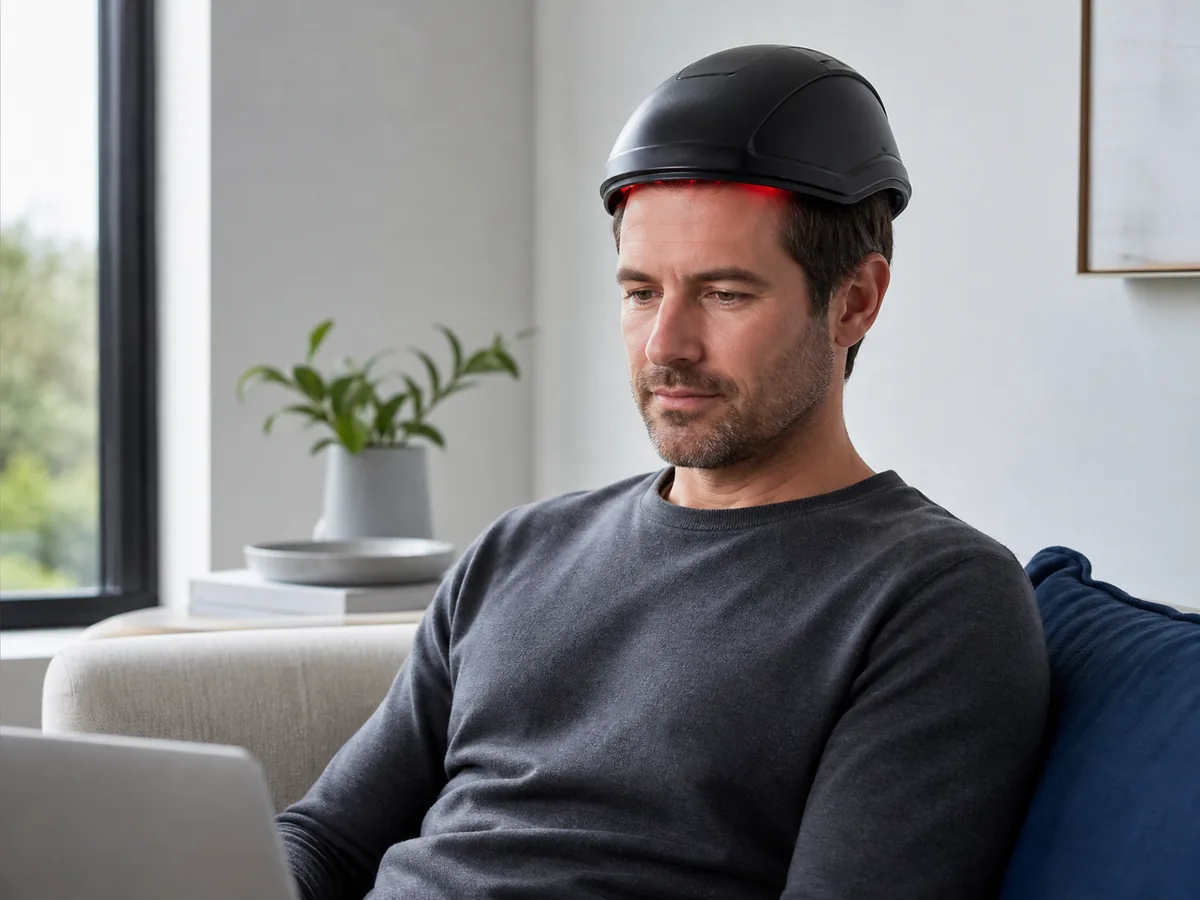
A two-center trial randomized 60 adults and analyzed 59. Participants used a 655-nanometer helmet for 25 minutes every other day for 16 weeks. The active group increased hair density by 41.90 hairs per square centimeter, versus 0.72 with sham.
The study also reported increased shaft thickness in the active group and a decrease in the sham group. It was small and short, and its exact device output matters. A large numerical change in a tattooed target area does not guarantee the same visible transformation for every person.
04
Clearance, maintenance and conflicts need plain language
US device clearance is product-specific and commonly uses a substantial-equivalence pathway. It should not be translated into blanket FDA approval of red-light therapy as a category. Consumers should verify the exact device rather than borrow a claim from a different model.
Trials generally lasted 16 to 26 weeks, so long-term maintenance and optimal schedules remain less certain. Dryness, itching, scalp tenderness or warmth were reported in some studies, but a pivotal laser-comb trial excluded people with photosensitivity. Eye precautions and light-sensitive medicines or conditions depend on the exact device and its instructions. Diagnosis still matters before spending heavily on a device for unexplained loss.
Direct sources
Read the research
- Jimenez et al. — Multicenter sham-controlled laser-comb trials in men and women ↗American Journal of Clinical Dermatology (2014), PMID 24474647, DOI 10.1007/s40257-013-0060-6
- Yoon et al. — Helmet-type low-level light therapy randomized trial ↗Medicine (2020), PMID 32702878, DOI 10.1097/MD.0000000000021181
- Leavitt et al. — HairMax LaserComb double-blind sham-controlled study ↗Clinical Drug Investigation (2009), PMID 19366270, DOI 10.2165/00044011-200929050-00001
- FDA — 510(k) summary for a low-level laser hair device ↗Official device-specific regulatory summary; not category-wide approval
Editorial transparency
This article was prepared by the HairstyleChange Research Desk from the cited sources. It has not been presented as medical review by a named clinician. Corrections and qualified reviewer enquiries are welcome through our contact page.
How we research and correct articles ↗