01
The proposed benefit is an add-on effect
Most clinical studies did not compare microneedling with doing nothing. They asked whether a procedure added to topical minoxidil produced more change than minoxidil alone. That design makes the incremental effect—not general hair growth—the central question.
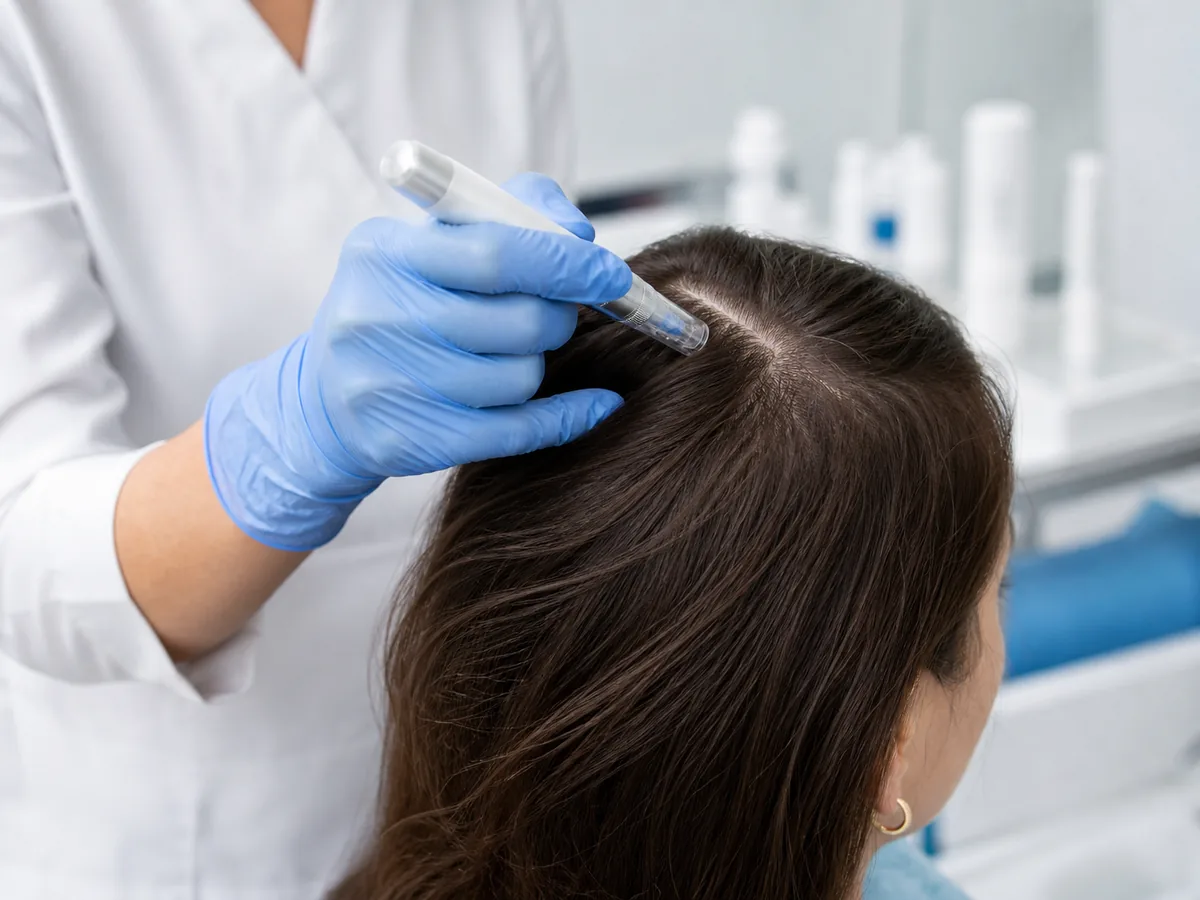
Needling may trigger wound-response pathways and change topical penetration, but those mechanisms do not specify an effective or safe home protocol. Depth, frequency, device sterility and scalp condition materially change the exposure.
02
The first pilot produced a striking result
A 2013 evaluator-blinded study randomized 100 men to weekly 1.5-millimeter rolling plus twice-daily 5% minoxidil or minoxidil alone for 12 weeks. Mean target-area count change was 91.4 hairs in the combination group versus 22.2 in the minoxidil group.
A later trial in 68 men, with 60 completing, also favored eight 1.5-millimeter sessions plus minoxidil: mean change 12.82 versus 1.89 hairs in a one-square-inch target. The scale of benefit was much smaller than in the original study, and protocols and counting units complicate comparison.
03
A larger 2026 trial found no added benefit
A randomized study in 245 women compared 2% minoxidil alone with minoxidil plus 500- to 550-micrometer microneedling monthly or every two weeks. At 24 weeks, adjusted differences versus minoxidil were minus 0.88 and minus 3.45 non-vellus hairs per square centimeter; neither demonstrated an incremental benefit.
This does not prove that every deeper or weekly protocol is ineffective, because the exposure differed from earlier trials. It does prevent a confident blanket claim. The largest study in this set did not reproduce the simple idea that adding needling necessarily improves minoxidil.
04
Protocol uncertainty is also a safety issue
Pain, bleeding, erythema, scaling, folliculitis and infection are relevant risks, and altered topical absorption adds uncertainty. Trials excluded people with several scalp, bleeding and scar-related conditions. Their supervised procedures should not be converted into casual instructions from a blog.
Anyone considering a procedure should first have the type of hair loss and scalp health assessed by a qualified clinician. The honest evidence label is conflicting: promising signals in small trials, a current null result in a much larger one, and no universally validated protocol.
Direct sources
Read the research
- Dhurat et al. — Randomized evaluator-blinded microneedling pilot ↗International Journal of Trichology (2013), PMID 23960389, PMCID PMC3746236, DOI 10.4103/0974-7753.114700
- Kumar et al. — Microneedling plus minoxidil in male androgenetic alopecia ↗Journal of Cutaneous and Aesthetic Surgery (2018), PMID 30886475, DOI 10.4103/JCAS.JCAS_130_17
- Zhang et al. — Microneedling plus 2% minoxidil in female pattern hair loss ↗Journal of Cosmetic Dermatology (2022), PMID 36214061, DOI 10.1111/jocd.15424
- Liu et al. — Minoxidil with or without microneedling in women ↗Journal of the American Academy of Dermatology (2026), PMID 42190753, DOI 10.1016/j.jaad.2026.03.123
Editorial transparency
This article was prepared by the HairstyleChange Research Desk from the cited sources. It has not been presented as medical review by a named clinician. Corrections and qualified reviewer enquiries are welcome through our contact page.
How we research and correct articles ↗