01
The short answer
Researchers compared hair from 19 women who regularly used bleaching, dyeing, straightening or a combination with hair from 6 women who reported no specific treatment. Under scanning electron microscopy, the treatment group had significantly higher damage scores.
The ordinary clinical examination and light microscopy did not show a significant group difference. That contrast is important: subtle surface changes can exist before they are obvious to the eye, but microscopy findings are not a direct prediction of how one person's hair will look or break.
02
What the microscope was scoring
The study used a standardized scale for the hair cuticle and deeper exposure. Lower grades described an irregular cuticle without cracks; higher grades included lifted cuticle, holes and partial exposure of the cortex.
The cuticle is the outer protective layer of the hair fiber. When its overlapping scales become irregular or lifted, friction and rough feel may increase. The study assessed structure, not a consumer product's shine claim or a salon result rating.
03
What the study cannot separate
The study was cross-sectional: researchers examined existing routines and hair rather than randomly assigning people to one treatment. Participants could use one procedure or a combination, so the design cannot tell us how much of the observed difference came from bleach, permanent color, straightening, heat, frequency or aftercare.
The sample was also small and uneven — 19 in the treatment group and 6 controls. The result is a useful signal, not a precise damage forecast for a particular formula, salon or hair texture.
04
Why before-and-after planning still matters
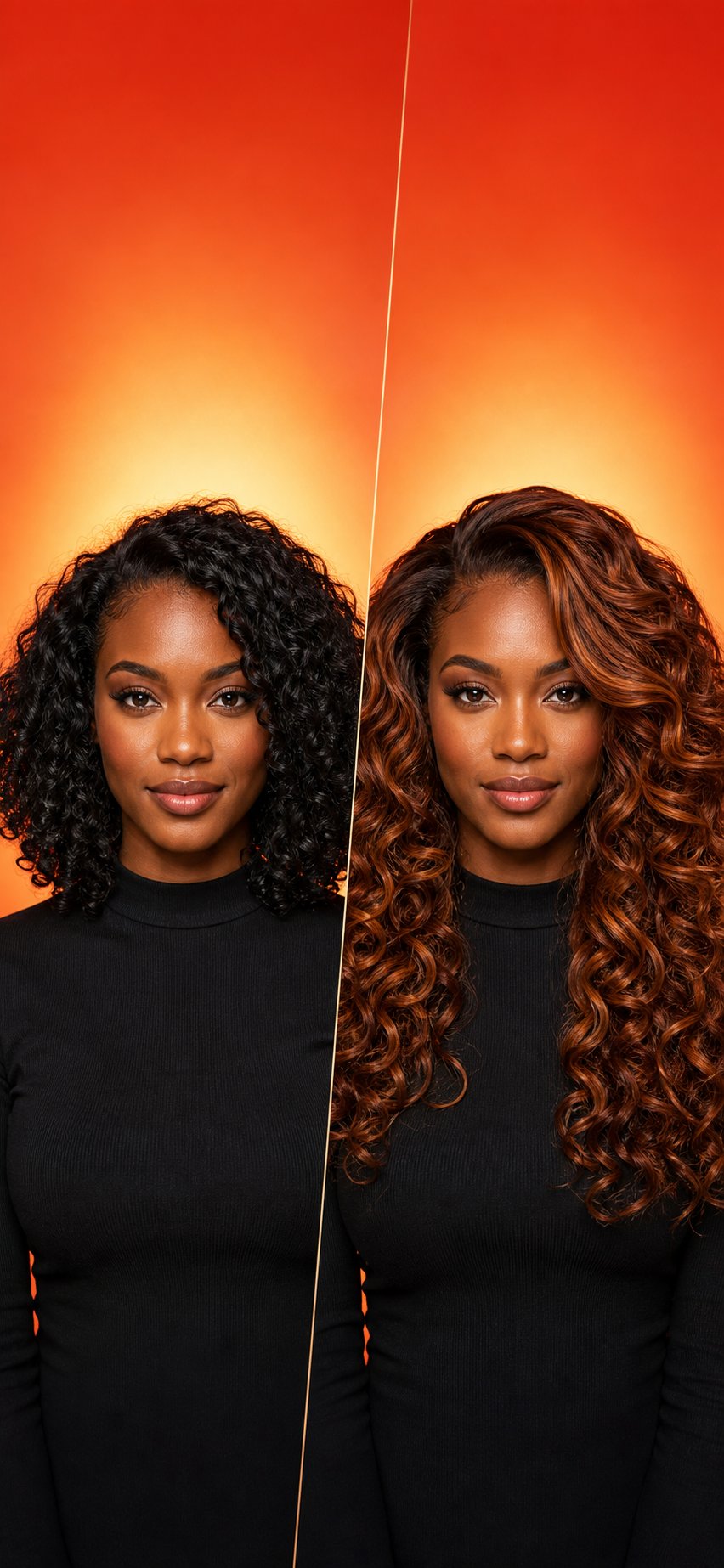
Hair color and texture changes can be visually dramatic, but an AI preview is only a concept. It cannot measure the condition of your hair fiber, identify prior chemical overlap or tell a colorist what lift is safely achievable.
Use a preview to discuss direction: warmth, depth, length and silhouette. Use a qualified professional and strand testing to make decisions about chemistry, timing and whether the desired change should happen in stages.
05
Practical questions for a consultation
Bring an accurate history of prior bleach, dye, relaxer, perm and smoothing services, including home products. Ask what change is realistic in one appointment, which sections would be processed again and what signs would make the professional stop.
No topical product can make a chemically altered fiber identical to untouched hair. Conditioning and styling may improve manageability and appearance, while the underlying degree of structural change depends on the process and the starting fiber.
Direct sources
Read the research
- Kaliyadan et al. — Scanning Electron Microscopy Study of Hair Shaft Damage ↗International Journal of Trichology (2016), PMID 27601867, DOI 10.4103/0974-7753.188035
- Open-access full text ↗PubMed Central copy with the scoring method, figures and limitations
Editorial transparency
This article was prepared by the HairstyleChange Research Desk from the cited sources. It has not been presented as medical review by a named clinician. Corrections and qualified reviewer enquiries are welcome through our contact page.
How we research and correct articles ↗